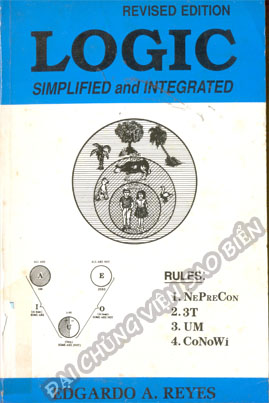
| Revised Edition Logic Simplified And Integrated | |
| Tác giả: | Edgardo A. Reyes |
| Ký hiệu tác giả: |
RE-E |
| DDC: | 160 - Logic học |
| Ngôn ngữ: | Anh |
| Số cuốn: | 1 |
Hiện trạng các bản sách
|
||||||||||||||||
| 1 | THE MEANING OF LOGIC | 1 |
| 1.1 | Definition of Logic | 2 |
| 1.2 | Meaning of Correct Thinking | 3 |
| 1.3 | Correct Thinking and Logic | 4 |
| 1.4 | Logic as a Science | 5 |
| 1.5 | Objects of a Science | 6 |
| 1.6 | Logic as Philosophy | 7 |
| 1.7 | Logic as Practical Philosophy | 8 |
| 1.8 | The Material and Formal Objects of Logic |
9 |
| 1.9 | Division of Logic | 9 |
| 1.1 | Importance of Logic | 10 |
| 2 | THE SIMPLE APPREHENSION AND THE IDEA | 15 |
| 2.1 | The Formation of an Idea | 15 |
| 2.2 | Reality | 15 |
| 2.3 | The sense Image | 15 |
| 2.4 | The Phantasm | 18 |
| 2.5 | The Idea and Simple Apprehension | 18 |
| 2.6 | Substance or Essence or Nature | 19 |
| 2.7 | Properties of an Idea | 23 |
| 2.8 | Comprehension of an Idea | 23 |
| 2.9 | The Tree of Being | 25 |
| 2.1 | Extension of an Idea | 26 |
| 2.11 | Inverse Relation of Comprehension and Extension |
26 |
| 3 | THE TERM | 35 |
| 3.1 | Definition of Term | 35 |
| 3.2 | Terms ( and Ideas) classified According to Actual or Functional Extension |
36 |
| 3.3 | Universal | 37 |
| 3.4 | Particular Terms | 39 |
| 3.5 | Distributive and collective Terms | 42 |
| 3.6 | Determining the Quantity or Extension of the Subject |
43 |
| 4 | JUDGEMENT | |
| 4.1 | Description and Definition of the Judgement | 57 |
| 4.2 | Affirmative Judgement | 57 |
| 2.3 | Negative Judgement | 59 |
| 2.4 | Elements of Judgement | 59 |
| 4.5 | Further Discussion on the Judgement | 60 |
| 5 | THE SIMPLE CATEGORICAL PROPOSITION | 63 |
| 5.1 | Definition of a Proposition | 63 |
| 5.2 | The simple Categorical Proposition | 63 |
| 5.3 | Elements of a Proposition | 64 |
| 5.4 | The Logical Form of the Proposition | 64 |
| 5.5 | Reduction to Logical Form | 65 |
| 5.6 | Determining the Concrete Logical Form | 66 |
| 5.7 | Properties of Propositions | 73 |
| 5.8 | A, E, I and O Propositions | 74 |
| 5.9 | The U Proposition | 74 |
| 5.1 | The Quantity or Extension of the Predicate | 79 |
| 5.11 | The Quantity of the Predicate in an Affirmative Propositions |
81 |
| 5.12 | The Predicate in a Negative Proposition | 81 |
| 5.13 | Summary of Rules thus Far | 81 |
| 6 | IMMEDIATE INFERENCE OR THE REEXPRESSION OF A PROPOSITION |
87 |
| 6.1 | Immediate Inference | 87 |
| 6.2 | Importance of Immediate Inference | 87 |
| 6.3 | Classification of Ideas (or Terms) According to Relations |
87 |
| 6.4 | Kinds of Immediate Inference | 91 |
| 6.5 | Logical Opposition of Categorical Proposition | 91 |
| 6.6 | Logical Triangle of Opposition: Logical Opposition of the A, E and U Propositions |
91 |
| 6.7 | The A-E-U and the A-E-I-O Systems | 92 |
| 6.8 | Logical Square of Opposition: Logical Opposition of the A,E,I and O ppositions |
92 |
| 6.9 | Opposition in a Strict Sense Contradictories and Contraries |
93 |
| 6.1 | Opposition in a Broad Sense: Subcontraries and Subalterns | 96 |
| 6.11 | Conversion | 115 |
| 6.12 | Kinds of Conversion | 115 |
| 6.13 | Conversion of Propositions | 116 |
| 6.14 | Conversion Simplified | 117 |
| 6.15 | Diagrammatic Conversion of Propositions | 119 |
| 6.16 | Obversion | 120 |
| 6.17 | Practical Exercises on Conversion and Obversion | 131 |
| 6.18 | Other Ways of Reexpression | 135 |
| 6.19 | Integrated Reexpression of Propositions: "COCOCOCO" |
135 |
| 6.2 | Integrated Summary of Reexpression or Immediate Inference | 141 |
| 7 | THE REASONING PROCESS | 143 |
| 7.1 | Description of Reasoning | 143 |
| 7.2 | Kinds of Reasoning | 143 |
| 7.3 | Description of Deductive Reasoning | 144 |
| 7.4 | Elements and Definition of Deductive Reasoning | 145 |
| 7.5 | Deductive Argumentation The Categorical Sillogism | 145 |
| 7.6 | Elements of a Syllogism | 145 |
| 7.7 | Validity and Truth in the Sillogism | 155 |
| 7.8 | Relation of Validity and Truth | 155 |
| 7.9 | Terms Classified According to Exactness of Meaning | 156 |
| 7.1 | Principles of Identity and Distinction (Non - Identity) in a Syllogism |
157 |
| 7.11 | Rules for the Categorical Syllogism Summarized | 165 |
| 7.12 | Derivation and Explanation of the Rules for the Categorical Syllogisms Summarized |
186 |
| 7.13 | Complete Step By Step Analisis of the Four Rules | 188 |
| 7.14 | A Brief Practical Summary of the Four Rules | 190 |
| 7.15 | Figures of the Categorical Syllogism | 215 |
| 7.16 | Special Use of the Figures | 215 |
| 7.17 | Moods of the Categorical Syllogism | 217 |
| 7.18 | Particular Rules for the Figures | 218 |
| 7.19 | Reduction to the First Figure | 219 |
| 7.2 | How to Reduce to the First Figure | 219 |
| 8 | IMPERFECT SYLLOGISM | 221 |
| 8.1 | Imperfect Syllogism | 221 |
| 8.2 | The Enthymeme | 221 |
| 8.3 | The Polysyllogism | 229 |
| 8.4 | The Epichireme | 231 |
| 8.5 | The Sorites | 233 |
| 8.6 | Summary of Imperfect Syllogism | 234 |
| 9 | HYPOTHETICAL SYLLOGISM | 237 |
| 9.1 | The Hypothetical Syllogism | 237 |
| 9.2 | The Conditional Syllogism | 248 |
| 9.3 | The Nonconjunctive or Incomplete Disjunctive Syllogism |
247 |
| 9.4 | The Strict Disjunctive Syllogism | 248 |
| 9.5 | The Broad Disjunctive Syllogism | 250 |
| 9.6 | The Dilemma | 255 |
| 9.7 | Integrated Summary of Logical Opposition and Hypothetical Syllogism |
257 |
| 10 | FALLACIES | 261 |
| 10.1 | Fallacies | 261 |
| 10.2 | Fallacies of Out of Topic ( Ignorantia Elenchi) | 262 |
| 10.3 | Fallacy of No Proof ( Petitio Principii) | 263 |
| 10.4 | Fallacy of Weak or Apparent Proof ( Non- Sequitur) | 264 |
| 10.5 | False Universalization ( or Generalization) | 266 |
| 10.6 | Multiple Questions | 266 |
| 10.7 | Summary of the Fallacies | 267 |
| 11 | INDUCTION | 275 |
| 11.1 | Introduction to Induction | 275 |
| 11.2 | Definition and Kinds of Induction | 276 |
| 11.3 | Syllogistic Fundarnentum or Rationale of Induction | 278 |
| 11.4 | Proof of the Minor: Nature is the Sufficient Reason of Uniform Phenomena |
278 |
| 11.5 | Proof of the Major: Establishing Causal Laws | 279 |
| 11.6 | Determining Probable Causes | 280 |
| 11.7 | Criteria For Determining Probable Causes | 280 |
| 11.8 | Criteria For a Good Hypothesis | 282 |
| 11.9 | Formulation and Confirmation of the Hypothesis | 284 |
| 12 | INTRODUCTION TO SYMBOLIC LOGIC | 291 |
| 12.1 | Compound Propositions | 291 |
| 12.2 | Symbolic Logic | 291 |
| 12.3 | Symbols for Symbolic Logic | 292 |
| 12.4 | Truth Values of Compound Propositions | 293 |
| 12.5 | Truth Values of Contradictory Propositions (-A) | 293 |
| 12.6 | Truth Values of Strict Conjunctive Compound Propositions (A + B) |
294 |
| 12.7 | Truth Values of Nonconjunctive or Incomplete Disjunctive Compound Propositions [1 (A + B)] |
295 |
| 12.8 | Truth Values of Strict Disjunctive Compound Propositions ( A o B) |
296 |
| 12.9 | Truth Values of Broad Disjunctive Compound Propositions ( A o B) |
297 |
| 12.1 | Truth Values of the Conditional Compound Propositions ( A B) |
298 |
| 12.11 | Truth Values of the Biconditional Compound Proposition ( A B ) |
300 |
| 12.12 | Summary of the Truth Values of Compound Propositions |
301 |
| 12.13 | Logical Grouping Signs or Punctuations | 302 |
| 12.14 | Solving Problems in Symbolic Logic | 303 |
| 12.15 | Symbolic Logic and Aristotelian Thomistic Logic | 304 |
| Bibliography | 313 | |
| LISTS OF ILLUSTRATIONS | ||
| figure 1.1 | Division of Phylosophy | 3 |
| 1.2 | Objects of a Science | 7 |
| 1.3 | Science Chart | 8 |
| 1.4 | Main Outline of Logic | 10 |
| figure 2.1 | Illustrative Outline of the Formation of an Idea and of a Term |
16,17 |
| 2.2 | The Tree of Being | 25 |
| 2.3 | Chart Showing Inverse Relation of Comprehension and Extension |
26 |
| 2.4 | Illustrative Inverse Relation of Comprehension and Extension |
27 |
| Figure 3.1 | Use of Terms in Communication | 35 |
| 3.2 | Classification of Terms According to functiional Extension |
37 |
| 3.3 | Outline of the Classification of the Particular | 39 |
| 3.4 | Illustration of the Exclusive Particular | 40 |
| 3.5 | Illustrative Classification of Terms | 42 |
| Figure 4.1 | Agreement or Disagreement of Ideas | 57 |
| 4.2 | Illustration of the Affirmative Judgment | 58 |
| 4.3 | Illustration of the Negative Judgment | 59 |
| Figure 5.1 | The Expressed Logical Form of the Proposition | 64 |
| 5.2 | Chart of the Kinds of Proposition | 73 |
| 5.3 | Diagram of the A, E, I, O, U Proposition | 74 |
| 5.4 | Chart Summarizing Rules Thus Far | 82 |
| Figure 6.1 | Illustrative Opposition of A, E, U Proposition | 91 |
| 6.2 | The A, E, I, O and U Propositions Illustrated | 94 |
| 6.3 | Illustrative Opposition of the A, E , I and O Proposition | 95 |
| 6.4 | Memory Aid for Logical Opposition of A, E, I and O | 98 |
| 6.5 | Chart of the Logical Opposition of A, E, I, O and U Propositions | 100 |
| Figure 9.1 | Integration of Hypothetical Syllogisms With A, E, I, O | 237 |
| Figure 12.1 | Table of Truth Values of Contradictory Propositions | 294 |
| 12.2 | Table of Truth Values of Strict ConJunctive Compound Propositions |
295 |
| 12.3 | Table of Truth Values for Nonconjunctive Compound Propositions |
296 |
| 12.4 | Table of Truth Values Up to Strict Disjunctive Compound Propositions |
296 |
| 12.5 | Table of Truth for the Broad Disjunctive Compound Propositions |
297 |
| 12.6 | Table of Truth Values for the Conditional Compound Propositions |
299 |
| 12.7 | Table of Truth Values for the Biconditional Compound Propositions |
300 |


Các tác phẩm cùng thể loại
-
 Tác giả: Bertrand Russell
 -

-
 Tác giả: Trần Xuân Tiên, Phạm Xuân Thu
 -
-
 Tác giả: Trần Đức An
 -
-
 Tác giả: Lê Tử Thành
 -
-
-
 Tác giả: Nguyễn Hiến Lê
 -
-
 Tác giả: Hồ Thích
 -
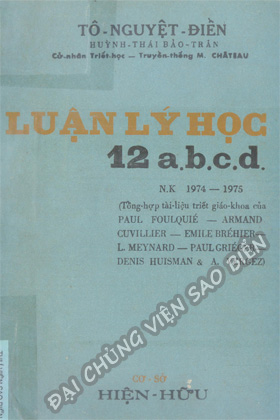 Tác giả: Tô Nguyệt Điền
 -
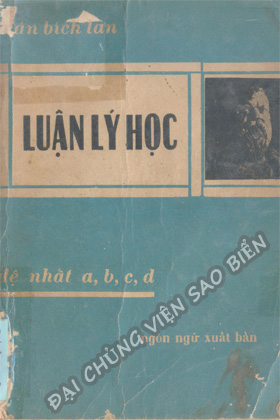 Tác giả: Trần Bích Lan
 -

-
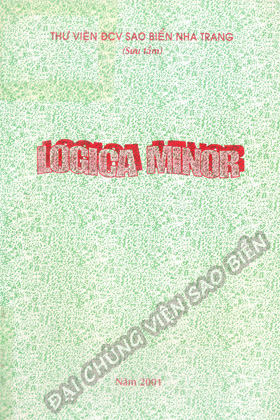 Tác giả: ĐCV Sao Biển Nha Trang
 -
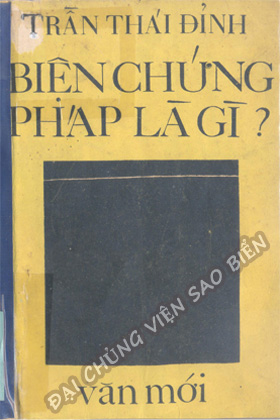 Tác giả: Trần Thái Đỉnh
 -
 Tác giả: Lm. Phaolô Lê Tấn Thành
 -
-
-
-
-
 Tác giả: Tô Duy Hợp, Nguyễn Anh Tuấn
 -
 Tác giả: Hoàng Chúng
 -
-
 Tác giả: PGS Vũ Ngọc Pha
 -
 Tác giả: Phan Trọng Hòa
 -
-
-
 Tác giả: Trần Nhựt Tân
 -
 Tác giả: W.A. Pickard-Cambridge, Lê Duy Nam
 -
 Tác giả: Lm. Micae Lê Nguyễn Hoài Vũ
 -
 Tác giả: Janine Dupuy
 -