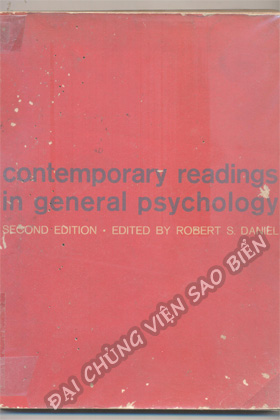
| contemporary reading in general psychology |
|
| part1 psychology is a scientific enterprise |
2 |
| 1 the scientist in our unique society |
7 |
| 2 the message of science |
11 |
| sciencie and its presuppositions |
16 |
| the psychology of the scientist |
20 |
| what every or less scientific method |
23 |
| part2 psychology is the science the behavior of organisms |
29 |
| the age of psychology in the US |
30 |
| psychology in mid twentieth centry |
33 |
| the basic postulates of psychology |
43 |
| psychology as a science |
48 |
| an introduction to psychology methodology |
53 |
| unity in psychology |
64 |
| summary |
69 |
| part3 behavior is adaptive |
75 |
| arrsted vision |
76 |
| the involuntary bet |
80 |
| the development of problem-solving ability |
84 |
| research on skills |
90 |
| how to teach animal |
95 |
| man's mysterious memory machine |
99 |
| memory systems in the brain |
106 |
| information and memory |
110 |
| where were you the night of April 23,1935 |
115 |
| part 4 behavior is variable |
121 |
| the variety of human experience |
122 |
| your chill's intelligence |
127 |
| genetics and equality |
133 |
| race and intelligence |
138 |
| are the sexs rwally equal? |
140 |
| facts about mental deficiency |
143 |
| concerning the nature and nuture of genius |
146 |
| what makes a person creative |
153 |
| part5 behavior is development |
159 |
| early environment |
161 |
| the k-puppies |
165 |
| the early development of the parent-child relationship |
168 |
| how childdren form mathematical concept |
174 |
| human infancy and the ontogenesis of behavior |
178 |
| the evolution of mind |
191 |
| animal intelligence |
196 |
| ctitical periods in behavior development |
200 |
| the misbehavior of organisms |
213 |
| part6 behavior is dynamic |
219 |
| the psychology of boredom |
221 |
| what people dream about |
224 |
| does higher education influence student values |
228 |
| the psychology of toleration |
232 |
| theme and variations |
235 |
| some hypotheses of psycho-analysis |
237 |
| what's nervous breakdown, anyhow? |
242 |
| the nature and measurement of anaxiety |
245 |
| the measurement of motivation |
255 |
| part7 the behaving organism is biological |
265 |
| a biologist looks at human nature |
267 |
| speech and thought |
276 |
| the physical basis of mind: a philosopher's symposium |
279 |
| that wonderful machine , the brain |
281 |
| brain rhythms and lerning |
289 |
| how much can we see? |
293 |
| vision and behaviour |
295 |
| fact or fiction |
299 |
| why we have two ears |
303 |
| part8 the behaving organism is social |
309 |
| our changing conception of human nature |
311 |
| the study of social behaviour |
320 |
| opinions and social pressure |
324 |
| everybody know |
329 |
| non-verbal communication |
332 |
| the nature of teamwork |
336 |
| the affectional responses in the infant monkey |
341 |
| a case for graduated unilateral disengagement |
351 |
| part9behavior can be controlled |
357 |
| causality and the science of human behavior |
359 |
| when is human behavior predetermined ? |
367 |
| implications of recent advances inprediction and control of behavior |
375 |
| behavior control and social responsibility |
380 |
| the psychologist servises in solving daily problems |
386 |
| and the space frontier |
393 |
| aptitude test: can they steer you to success? |
400 |
| don’t get trapped by a psychoquak |
404 |
| four great lacks in mental heath |
408 |
| the myth of mental illness |
411 |




 Tác giả: Phạm Minh Hạc

 Tác giả: J. Piaget
 Tác giả: Nguyễn Khắc Viện